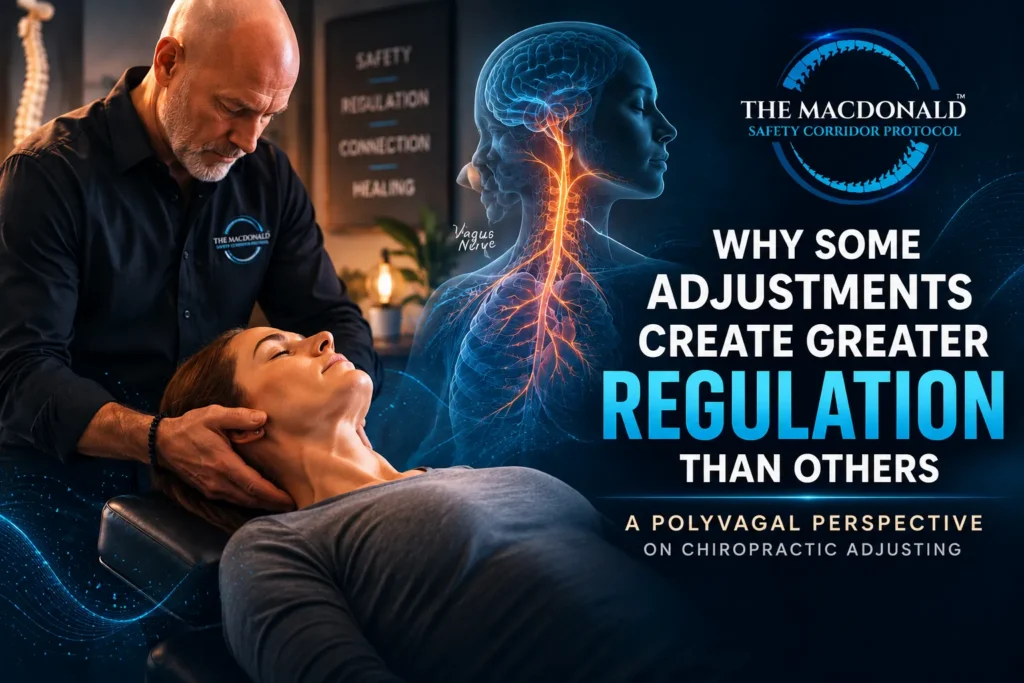
How the MacDonald Safety Corridor Protocol Integrates Nervous System Science into Chiropractic Adjusting
After more than 27 years in practice, there is one question that has fascinated me more than almost any other:
Why do two seemingly identical adjustments produce completely different responses?
You have likely seen it yourself.
Two people present with similar findings. They have similar postural distortions, similar restrictions, and receive what appears to be the same adjustment.
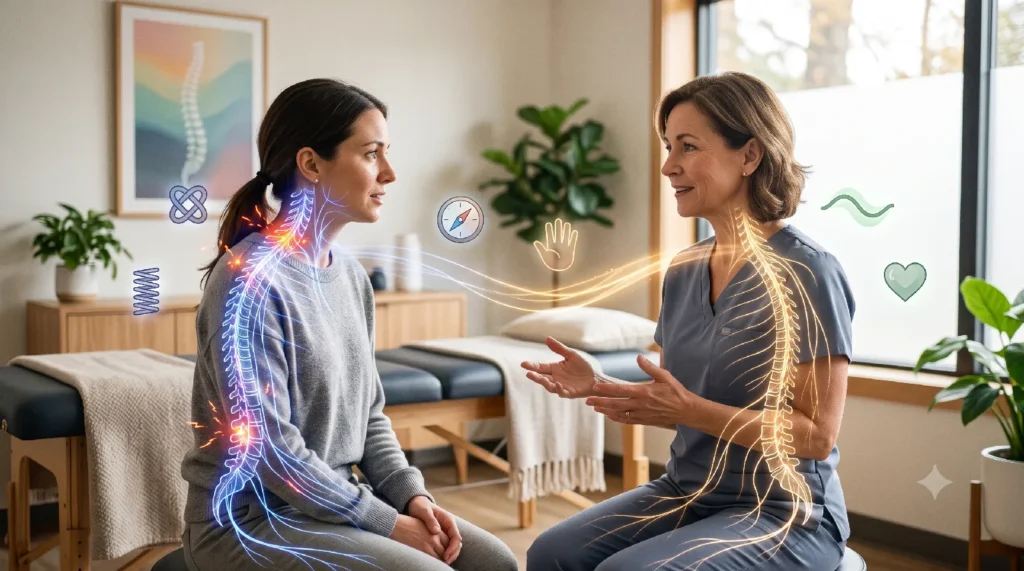
One patient takes a deep breath, their shoulders drop, their face softens, and they leave feeling lighter and more connected.
The other stiffens, guards, and seems to absorb very little of the adjustment.
For years, I viewed these differences primarily through a biomechanical lens. Maybe the adjustment wasn’t specific enough. Maybe the patient needed more force. Maybe they needed additional areas addressed.
While those factors certainly matter, I began to realize they didn’t fully explain what I was observing.
Something else was influencing the outcome.
The answer began to clarify when I was introduced to Polyvagal Theory.
What I discovered changed not only how I viewed the nervous system but also how I viewed the chiropractic adjustment itself.
The Missing Piece
One of the greatest strengths of chiropractic has always been its understanding that the body functions as an integrated whole.
Long before neuroscience began discussing neuroplasticity, interoception, and autonomic regulation, chiropractors recognized that structure and function were intimately connected.
What Polyvagal Theory gave me was a modern framework for understanding why patient responses vary so dramatically.
Developed by Dr. Stephen Porges, Polyvagal Theory describes how the nervous system continuously evaluates the environment for cues of safety and danger.
This process happens automatically and largely outside of conscious awareness.
Dr. Porges refers to this process as neuroception.
Before a patient consciously decides whether they feel safe, their nervous system has already made an assessment.
The question is not:
“Do I feel safe?”
The question is:
“Does my nervous system believe I am safe?”
This distinction is incredibly important inside a chiropractic office.
Because every adjustment is being received by a nervous system that is already operating in a particular state.
Not All Nervous Systems Walk Into Your Office the Same
Some patients arrive regulated and socially engaged.
They make eye contact. Their breathing is relaxed. Their voice has tone and expression. Their body moves with relative ease.
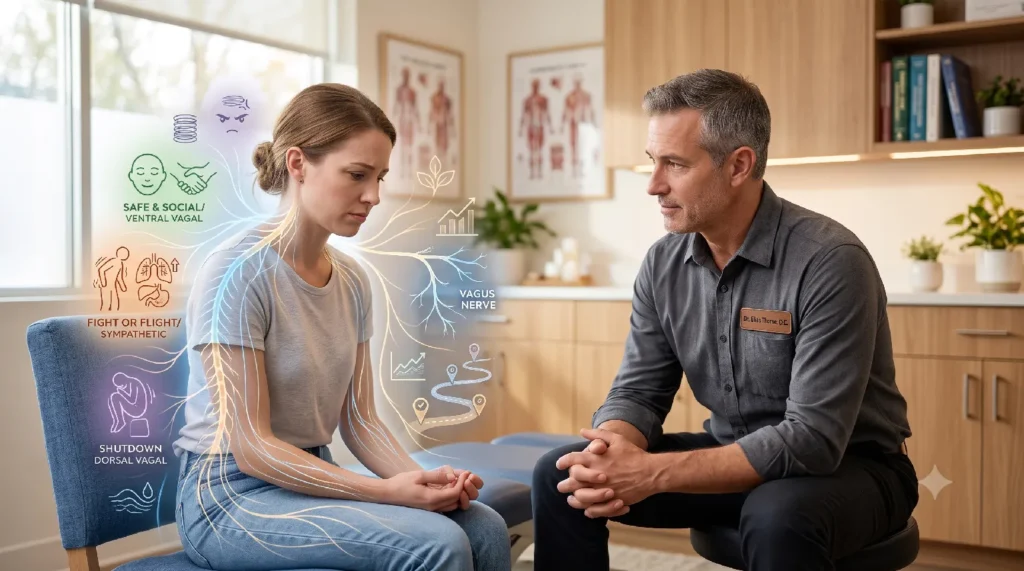
Others arrive carrying a very different physiological state.
Their shoulders are elevated.
Their jaw is tight.
Their breathing is shallow.
Their eyes constantly scan the room.
Their nervous system is operating in a protective state.
Many of these individuals have been functioning in that state for years.
In some cases, decades.
The adjustment itself may be perfectly delivered, but if the nervous system remains highly defensive, the overall response can be very different than what we expected.
This realization forced me to ask a different question.
Instead of asking:
“Where should I adjust?”
I began asking:
“How is this nervous system likely to receive this adjustment?”
That single question became the foundation of the MacDonald Safety Corridor Protocol.
The Birth of the MacDonald Safety Corridor Protocol
The MacDonald Safety Corridor Protocol was developed through years of clinical observation, continual learning, and a growing understanding of Polyvagal Theory.
It is not a departure from chiropractic principles.
It is an evolution of how we apply them.
The protocol recognizes that while spinal mechanics matter, the state of the nervous system matters too.
Our goal is not simply to create movement.
Our goal is to help create the conditions in which the nervous system can better receive and integrate the adjustment.
In simple terms, we are constantly attempting to reduce danger cues and increase safety cues throughout the entire adjustment process.
This applies before the adjustment, during the adjustment, and after the adjustment.
We call this process the Safety Sandwich.
The Safety Sandwich
The Safety Sandwich is one of the central concepts within the MacDonald Safety Corridor Protocol.
Step One: Create Safety
Before an adjustment ever occurs, the nervous system is gathering information.
How predictable is this interaction?
How safe does this environment feel?
How is the doctor’s voice?
How does the doctor’s touch feel?
How relaxed is the setup?
Simple factors such as communication, positioning, pacing, and contact quality can significantly influence how the nervous system interprets the experience.
Step Two: Remove the Danger Cue
The adjustment itself becomes the center of the Safety Sandwich.
The adjustment is designed to reduce a mechanical stressor, tension pattern, fixation, or area of dysfunction that may be contributing to ongoing defensive physiology.
This is the traditional strength of chiropractic.
The adjustment helps remove a potential source of interference.
Step Three: Add a Safety Cue
This is where many chiropractors stop.
Within the MacDonald Safety Corridor Protocol, we intentionally finish by introducing a safety cue.
This may involve gentle compression, traction, supportive contact, or simply allowing the nervous system a moment to integrate the change.
The goal is to reinforce a message of safety immediately following the adjustment.
The adjustment removes the danger cue.
The safety cue helps anchor the new experience.
Force Rapport Versus Force Delivery
One of the biggest shifts Polyvagal Theory created in my practice was changing how I think about force.
Many chiropractors are taught to focus primarily on force delivery.
The question becomes:
“How much force is required to move this segment?”
I became more interested in force rapport.
Force rapport asks a different question:
“What amount of force can this nervous system comfortably receive?”
The answer is not always the same.
Some patients need a stronger input.
Others respond dramatically to a lighter, more precise adjustment.
When we match our force to the nervous system in front of us, we often see deeper physiological changes with less resistance.
Looking Beyond the Spine
Another important lesson from Polyvagal Theory is that the body operates as an integrated system.
This understanding led to the development of what we call the Five Locks within the MacDonald Safety Corridor Protocol.
These include:
- Upper cervical structures
- Upper ribs and thoracic inlet
- Lower ribs and diaphragm
- Pelvis and pelvic floor
- Cranial and fascial relationships
Each area influences how the body manages tension, movement, breathing, pressure, and regulation.
When these regions become restricted, the nervous system often adapts around those restrictions.
By improving movement and reducing tension throughout these key regions, we create additional opportunities for regulation to occur.
Measuring What Matters
One of the most exciting aspects of practicing through a Polyvagal lens is that regulation often becomes visible.
You can frequently observe changes immediately following an adjustment.
The patient’s face softens.
Their eyes brighten.
Their breathing deepens.
Their shoulders drop.
Their voice changes.
They move differently.
They often describe feeling lighter, calmer, clearer, or more present.
These observations remind us that chiropractic is about far more than simply moving joints.
It is about helping people function more effectively within their environment.
Why This Matters for Today’s Chiropractor
The world has changed.
People are carrying more stress than ever.
Many of our patients arrive overwhelmed, exhausted, disconnected, and stuck in long-standing patterns of protection.
As chiropractors, we have a unique opportunity.
Not because we treat stress.
Not because we treat emotions.
But because we interact directly with the nervous system every day.
Polyvagal Theory has given us a modern language for understanding what many chiropractors have observed clinically for generations.
The MacDonald Safety Corridor Protocol is our attempt to integrate that understanding into practical chiropractic care.
It allows us to look beyond the adjustment itself and consider the state of the nervous system receiving it.
Because perhaps the question is not simply whether the adjustment was delivered correctly.
Perhaps the more important question is:
Was the nervous system ready to receive it?
And when we begin asking that question, everything changes.
Frequently Asked Questions About the MacDonald Safety Corridor Protocol and Polyvagal Chiropractic
The MacDonald Safety Corridor Protocol is a chiropractic approach developed by Dr. Don MacDonald that integrates chiropractic principles with Polyvagal Theory and modern nervous system science. The protocol focuses on reducing danger cues, enhancing safety cues, and improving how the nervous system receives and integrates chiropractic adjustments.
Polyvagal Theory, developed by Dr. Stephen Porges, helps explain how the autonomic nervous system continuously evaluates safety and danger. In chiropractic practice, understanding a patient’s autonomic state may help explain why some individuals respond differently to similar adjustments. By considering nervous system regulation alongside biomechanics, chiropractors can develop a more complete understanding of patient responses.
Every patient arrives with a unique history, physiology, stress load, and autonomic state. While two patients may present with similar structural findings, their nervous systems may receive and process an adjustment differently. Factors such as neuroception, tension patterns, breathing mechanics, and perceived safety can influence how the body responds.
The Safety Sandwich is a core concept within the MacDonald Safety Corridor Protocol. It consists of three phases:
- Creating safety before the adjustment through communication, positioning, and touch.
- Delivering the chiropractic adjustment to reduce a potential danger cue.
- Reinforcing safety immediately afterward through supportive contacts, compression, traction, or integration holds.
The goal is to improve the nervous system’s ability to receive and integrate the adjustment.
Force rapport refers to matching the force of an adjustment to the needs of the individual nervous system. Rather than focusing solely on how much force is required to move a segment, force rapport considers how much force the patient can comfortably receive and integrate. The objective is precision, not simply power.
The Five Locks are key regions that commonly influence tension patterns, movement, and nervous system regulation:
- Lock 1: Upper Cervical Region
- Lock 2: Upper Ribs and Thoracic Inlet
- Lock 3: Lower Ribs and Diaphragm
- Lock 4: Pelvis and Pelvic Floor
- Lock 5: Cranial and Fascial Relationships
These regions help guide assessment and adjusting within the protocol.
The MacDonald Safety Corridor Protocol is better described as a framework or lens through which chiropractic care is delivered. Chiropractors can integrate its principles into many different adjusting styles and techniques. The emphasis is placed on nervous system regulation, safety cues, force rapport, and clinical observation.
Within a Polyvagal-informed practice, chiropractors may observe changes such as:
- Facial expression
- Eye engagement
- Breathing patterns
- Voice tone
- Posture
- Ease of movement
- Patient-reported changes in tension or awareness
These observations can provide additional insight into how the nervous system is responding.
Many chiropractors find that Polyvagal Theory provides a useful framework for understanding patient behavior, trust, predictability, and engagement. It can help practitioners create a more regulated clinical experience and communicate more effectively with patients throughout the care process.
Dr. Don and Brandi MacDonald teach the MacDonald Safety Corridor Protocol through live seminars, mentorship programs, The Informed Chiropractor community, and educational resources focused on neurologically informed chiropractic care and Polyvagal Theory.
Find more information’s about upcoming events at theinformedchiropractor.com
Continue Learning
- The MacDonald Safety Corridor Protocol
- What Is Polyvagal Chiropractic?
- Polyvagal Theory for Chiropractors
- Nervous System Regulation
- Neuroception for Chiropractors
- Vagus Nerve and Chiropractic Care
- Chiropractic Communication
- Patient Retention and Trust
- Pelvic Floor Chiropractic: Pelvis, Fascia & Nervous System - August 30, 2026
- Women’s Health and Pelvic Floor Care in Chiropractic Practice - August 4, 2026
- How to Teach Neuroception Simply in Practice - July 16, 2026