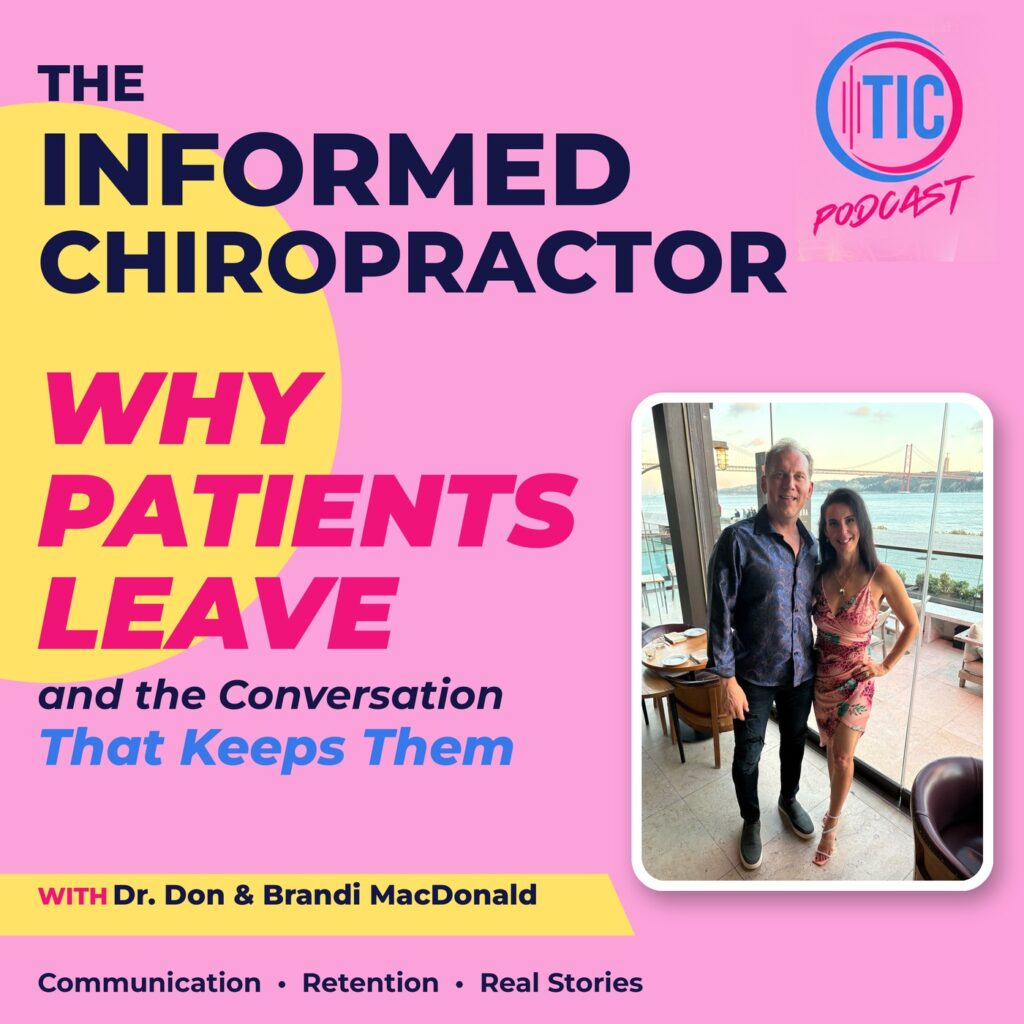
Brandi is back on the podcast. She’s my wife and my partner in practice, and she doesn’t get on the show often. Her schedule is full. This episode is about chiropractic patient retention, something almost every chiropractor wants to improve and few of us talk about honestly: why practice members leave care, and what we can do about it before it’s too late.
A lot of us spend time and money on Facebook ads and screenings to bring new people in. If the bucket is leaking out the back end, that gets frustrating fast. So we talk about the early signs that someone is going off-trend, and the conversations that keep them in care.
This is clinical experience shared by two people in practice, not medical advice. Chiropractic doesn’t treat conditions, and the stories here are individual experiences, not promises of results.
In this episode
- Why retention isn’t a strategy, and the difference between lead and lag indicators
- Trend lines, and why catching someone early is like correcting before you hit the ditch
- Results first: adjusting through a polyvagal lens
- Health trending: when something happens that nobody pre-framed
- Brandi’s three lenses: chiropractic, salutogenic and polyvagal
- Behavioural trends, and why your chiropractic assistants are your “connector detector”
- Amiable chiropractors, conflict and the rapport bank
- Scripting and table talk vs. incidental learning
- Brandi on storytelling, depth and meaning
Key takeaways
- Retention is a lag indicator. You can’t act on it directly. You act on lead indicators: what you do daily and weekly with practice members.
- Noticing early matters most. Once someone has decided they’re done, there’s usually no negotiating.
- Results come first. People need to notice a change in their physiology, and “feeling differently” counts.
- Pre-frame what might happen in care, including the chance they feel the same for a while.
- Watch behavioural trends: a missed second visit, a fixed schedule that suddenly doesn’t work, comments at the front desk.
- The truth isn’t conflict. The longer you wait to say something, the more it feels like conflict.
- Deeper relationships make the hard conversations easier.
Chiropractic patient retention isn’t a strategy
Brandi opened with something I hear tossed around all the time: “we have a good retention strategy.” Her point is that retention isn’t a strategy at all. It’s what we’d call a lag indicator, the result of doing some things differently when we communicate with people and noticing what’s happening before they leave.
We use this a lot with the docs in our 90-day program. Lead indicators are the actions you can actually take. A lag indicator, like growth in practice volume, is the end result. You can’t set the result as your goal because it has no direct action steps. Break it down into lead indicators and you have things you control. They don’t guarantee the result, but they’re how you get there.
Trend lines: notice before the ditch
If you’re driving on the highway and start drifting toward the ditch, the best time to correct is right away. Wait too long and it’s over. Trend lines in practice work the same way. It’s a bit like following a stock: when you see it just begin to go off trend, you have time to correct. Let it go too far and a bull market becomes a bear market. We want to notice these things earlier, both clinically and relationally.
The first trend line is results. That’s why we spend so much time on technique, adjusting through a polyvagal lens with the MacDonald Safety Corridor Protocol. We need to create a neurological change people can notice in their physiology, or nothing else matters. Communication comes next. (If you’d like more on this, we went into it in an earlier episode on trend lines as a communication skill.)
Health trending: when something unexpected happens
Brandi described health trending from the clinician’s side. The longer you’ve been in practice, the better you can anticipate how someone will move through phases of care. Earlier on, you still need a general idea of what should happen clinically.
In her view, the first sign someone will fall off care is that something happened that wasn’t pre-framed by the clinician: a flare-up, a surprise, or simply feeling exactly the same as when they came in. People don’t leave the moment that happens, but you have to catch it right away. They want to know that what’s happening is supposed to be happening. She also put it plainly: people come in to feel better, and moving them from feeling better to doing better is a communication skill. You’d better have tools to show them they’re doing better. As she said, we’re not necessarily trying to make people feel better; we’re trying to help them feel differently.
For my part, I go in with a picture of what I expect to see based on the state someone comes in with. That’s why we talk about different avatars. If we identify the avatar at the beginning, we can set a reasonable improvement trend line and know whether we’re on track.
Make sense of it yourself first
When someone comes in with a condition I’ve never heard of and asks, “Have you had experience with this?”, AI now lets me look it up. I’m not treating conditions. I’m looking through a salutogenic lens at improving the function of the nervous system. I want to know the physiological breakdown behind what’s going on, so I can put the pieces together while adjusting and keep them on trend.
Sometimes that takes creativity. If my force application or where I was adjusting isn’t moving the needle, I tell the person I’m going to look at it from a different angle. Everyone is a different Rubik’s Cube. When I explain that, people give you grace and leeway to get them back on trend. If you just keep saying “it takes time, listen to me, it’ll get better,” they’ll give you some visits, but eventually they get frustrated, and you can tell it’s done.
Brandi’s three lenses
Brandi described the way we look at people in practice as trifocals. The big lens is the chiropractic lens: the nervous system as the primary thing we work alongside, and a body that is innately intelligent and always making the best decision with the information it has. We’re not medicine, and we’re not treating disease. The second is the salutogenic lens: we aren’t just trying to prevent breakdown, we’re trying to rebuild, building people’s resourcing and capacity. The third is the polyvagal lens, which shapes how we see ourselves as a second nervous system in relationship with the practice member, and how we view the hierarchy of the nervous system.
On a first visit, she said, the person’s lens isn’t yours. You can’t pull all their lenses out at once or they’ll “fall down the stairs.” You slowly help them see beyond the one thing they came in for. The one thing is usually gone after a few visits. If you haven’t trended past it to the whole thing, their nervous system, by then, nothing you ask them to watch for later will make sense to them.
Behavioural trends and your “connector detector”
This is where your team matters. As chiropractors, we sometimes think we crushed a first visit. Then the person goes to the front and the chiropractic assistant sees it from a different lens. Your CAs are your connector detector. They can tell you, “That last person, I got a vibe.”
Brandi calls this the second kind of trending: behavioural trending. (If you’re a solo practitioner, as many docs in our Collective are, you’re wearing the CA hat yourself.) The number one sign is that people don’t make it to the second visit, and the doctor often doesn’t know why. Later on, it looks different: someone who came Tuesdays at five for months suddenly doesn’t know their schedule next week. That needs a response right away. She listed other signs we all know: stopping pre-booking or prepaying, missing appointments, and little comments at the front like “that was fast” or “I don’t know how much longer I have to come.”
By the time someone tells you they’re not interested in care anymore, she said, it’s too late. The opportunity was way before that. And she was honest that noticing doesn’t mean everyone stays. People leave happy and people leave unhappy. What you control is getting very good at noticing trends and responding quickly.
“It’s not conflict, it’s just the truth”
We attract a lot of amiable chiropractors, and amiable chiropractors find conflict hard. Brandi has taught this so many times: it’s not conflict, it’s just the truth. Even empathetic, amiable docs feel the energy change when someone goes off trend. We just get scared to say anything. And the longer you wait, the more it actually does feel like conflict.
So we role-play. Like professional athletes, we practise in practice first: take a scenario, take a skill, and practise stepping in with “Is everything okay? Can I take a moment?” when you notice something’s off. If you address it, or top up your rapport bank, right when you notice it, you have a much better chance of a long-lasting relationship. Every time you chip away at that rapport bank and say nothing, it gets a little worse. I’ve been there early in practice, and it felt yuck.
Brandi added a story about one of our young docs with a frustrated practice member, and talked about how unaddressed frustration turns into resentment on both sides. Her approach with long-term people is to pre-frame (“I know this might land differently than I mean it, so bear with me”) and then be honest, including telling them when they aren’t doing enough care to move the needle. Being honest because you care, and being human about being on this journey with them, is a huge part of retention we rarely talk about. For more on that side of things, see patient retention and trust.
Scripting vs. incidental learning
We’ll cover this properly in Toronto, and Brandi has a whole chapter on it in our upcoming book, The Polyvagal Shift. The short version: rather than scripts and table talk, incidental learning means noticing when someone opens a window, and offering a different perspective right then. Brandi compared it to baby birds: feed them when their mouths are open and they take it. She also drew on her early work in a daycare, where children learned through inviting play stations without feeling taught. Your office, and the lens you practise through, can be set up the same way.
A little more skill, not a new personality
My hope for the chiropractors and chiropractic assistants who come to these events is simple: that they leave with a little more skill. Most chiropractors already have 90% of communication. That last 10%, a few strategies for connecting with people, helps practice members re-engage in their own health and in the practice. Brandi added that many experienced offices already have plenty of depth; they just need to learn to step back, observe for a moment, and come back in. And the deeper your relationships, the easier the hard conversations become. You can read more of how we think about this on our chiropractic communication page.
Brandi closed with a reminder I love: your life is your story, and who you are is enough. It’s a matter of learning how to offer that perspective in a way someone can hear.
Join us in Toronto
We’ll go much deeper on all of this, the soft skills, the hard skills, and how to use them at the first visit, second visit, re-evaluations and regular visits, at The Gathering: The Communication Extravaganza, Saturday, December 5, 2026, 9 am to 5 pm, at the Delta Hotels by Marriott Toronto Airport & Conference Centre. Doctors, CAs, spouses and students are welcome. See the Toronto details and register.
Also coming up: The Polyvagal Shift in January, Healing the Chiropractor in Phoenix in January, two weeks in Australia including the Communication Extravaganza on the Gold Coast in February, and probably something in the UK in March. We’ll keep you posted.
Frequently asked questions
Why do patients leave chiropractic care?
In our experience, the first sign is usually that something happened in care that wasn’t pre-framed: a surprise, or feeling exactly the same with no change they can notice. Behavioural signs follow, like missing the second visit, schedule changes, stopping pre-booking, or comments at the front desk.
Is retention a strategy?
No. Retention is a lag indicator, the result of what you do. What you control are lead indicators: noticing health and behavioural trends early and responding to them on a daily and weekly basis.
What is a trend line in chiropractic care?
It’s the expected path of improvement for someone, based on the state they came in with. Watching it lets you notice early when someone begins to go off trend, clinically or relationally, while there’s still time to correct.
What role do chiropractic assistants play in retention?
They often see how a first visit really landed. A CA can be your “connector detector,” letting you know when someone didn’t connect even when the doctor thought the visit went well.
How do I bring up a concern without it feeling like conflict?
Address it as soon as you notice it. It’s not conflict, it’s the truth, and waiting makes it feel more like conflict. Practise first by role-playing, then use something simple like “Is everything okay? Can I take a moment?”
What is incidental learning in a chiropractic office?
Instead of scripts and table talk, it means noticing when a practice member opens a window of curiosity and offering a different perspective in that moment, so it lands naturally.
If you’d like a simple place to start with the nervous-system lens we talk about here, my free six-video course, Introduction to Chiropractic Through a Polyvagal Lens, is a good first step. And if you’d like ongoing support with all of this, the Informed Chiropractor Collective is where we keep working on it together.

- Why Patients Leave Care and the Conversation That Keeps Them: Communication in Chiropractic with Dr. Don and Brandi MacDonald - October 26, 2026
- Why the Pelvic Floor May Be the Missing Link in Polyvagal Chiropractic - October 25, 2026
- Trend Lines: The Chiropractic Communication Skill That Keeps Practice Members in Care - October 12, 2026