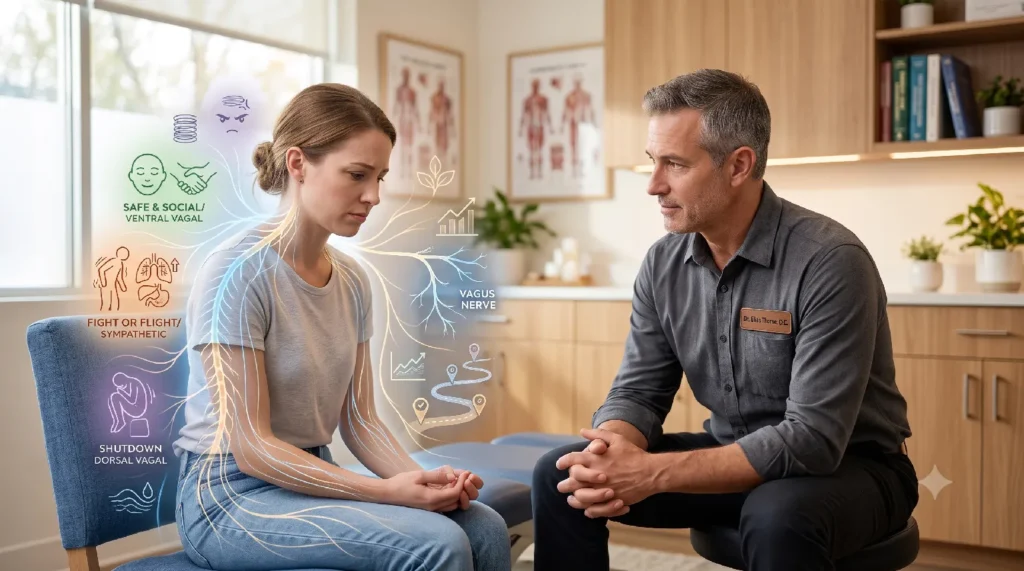
A patient walks into your office committed, consistent, and genuinely trying. They get adjusted. They follow recommendations. They want to feel better. And yet weeks later, something still is not shiftinNervous System Healing Explained Clearly
A patient walks into your office and tells you:
“I know my pain is better, but I still don’t feel like myself.”
Most chiropractors have heard some version of that statement.
The structure may be improving. Symptoms may be changing. Yet something deeper still feels stuck.
This is where understanding nervous system healing becomes important.
Many chiropractors eventually discover they are not simply asking whether care is working. They are asking a deeper question:
Why do some patients begin to reconnect, sleep better, breathe easier, and engage with life again while others remain guarded even when the mechanics improve?
The answer often lies within the nervous system.
What Nervous System Healing Really Means
Most people imagine healing as a straight line.
Something hurts.
The problem gets fixed.
The symptoms disappear.
The nervous system rarely works that way.
Instead, the nervous system functions more like an orchestra conductor, constantly evaluating the environment and deciding where the body’s resources should go.
When the system perceives safety, it can allocate energy toward:
- Recovery
- Growth
- Digestion
- Learning
- Social connection
- Repair
When the system perceives danger, energy shifts toward protection.
Common signs include:
- Muscle tension
- Shallow breathing
- Hypervigilance
- Digestive changes
- Poor sleep
- Increased pain sensitivity
Nervous system healing is not about achieving permanent calm.
It is about increasing the body’s ability to regulate, adapt, and recover.
Nervous System Healing Is Really About Adaptation
One of the biggest shifts in understanding healing comes when we stop viewing the body as broken.
More often, the body is adapting.
Many symptoms that frustrate patients are actually adaptive responses:
- Jaw tension
- Racing thoughts
- Digestive disruption
- Chronic guarding
- Sleep disturbances
- Persistent muscle tension
The problem is rarely that the body responded.
The problem is that the body may have remained in protection longer than necessary.
Polyvagal Theory offers a useful framework for understanding this process.
The nervous system constantly evaluates safety and danger through:
- Facial expressions
- Tone of voice
- Environment
- Relationships
- Touch
- Previous experiences
- Predictability
This process occurs largely outside conscious awareness.
Healing becomes possible when the nervous system receives enough cues of safety to begin shifting toward regulation.
Why Some Patients Change Quickly And Others Don’t
Every chiropractor has seen it.
Two patients arrive with similar symptoms.
One improves rapidly.
The other struggles to hold gains.
The difference is not always technique.
Often the difference is capacity.
Capacity refers to the nervous system’s ability to handle stress while remaining organized and adaptable.
Patients carrying high stress loads may be dealing with:
- Poor sleep
- Chronic stress
- Relationship difficulties
- Overwork
- Digital overload
- Blood sugar instability
- Social isolation
- Unresolved grief
When capacity is low, even excellent care can be difficult to integrate.
This understanding moves the conversation away from blame and toward curiosity.
What Helps The Nervous System Heal
While every person is different, healing often involves three essential ingredients.
1. Regulation
The nervous system benefits from experiences that increase coherence and safety.
Examples include:
- Quality sleep
- Movement
- Breathing awareness
- Predictable communication
- Meaningful connection
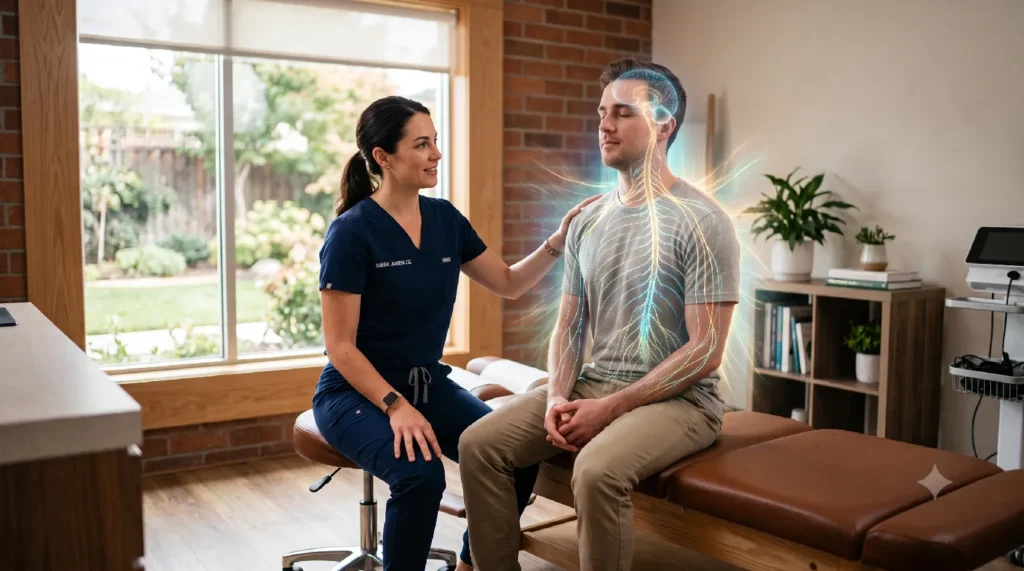
- Thoughtful touch
- Consistent routines
2. Load Reduction
Healing becomes difficult when stress continues to overwhelm the system.
Reducing unnecessary burden often creates space for recovery.
Examples include:
- Improving sleep habits
- Reducing overstimulation
- Simplifying routines
- Improving nutrition
- Addressing chronic stressors
3. Resilience Building
The goal is not avoiding stress.
The goal is becoming more adaptable.
Resilience grows through:
- Movement
- Social connection
- Recovery practices
- Meaningful challenges
- Emotional honesty
- Healthy routines
How This Changes Chiropractic Communication
When chiropractors understand healing through a regulation lens, communication becomes more effective.
Instead of focusing exclusively on symptoms, conversations expand to include:
- Sleep quality
- Recovery capacity
- Energy levels
- Emotional resilience
- Digestion
- Stress tolerance
Patients often feel relief when their experience finally makes sense.
They realize healing involves more than pain scores.
This creates stronger trust, better engagement, and often improved retention.
Important Cautions About Nervous System Healing
Like any framework, nervous system healing should be applied thoughtfully.
Not every symptom is primarily a nervous system issue.
Not every patient wants a detailed explanation.
Not every regulation strategy works for every person.
For example:
- Breathing exercises help some people.
- Others become more anxious when focusing on their breath.
- Gentle touch feels supportive for some.
- Others may need different approaches.
Good care requires observation, flexibility, and humility.
The goal is not forcing a theory onto patients.
The goal is understanding the person in front of you.
A More Useful Clinical Question
Perhaps the most valuable shift is moving away from asking:
“What is wrong with this person?”
And instead asking:
“What has this person’s nervous system been adapting to?”
This question changes:
- Assessment
- Communication
- Expectations
- Education
- Clinical decision-making
Most bodies are not trying to resist healing.
They are trying to survive.
When chiropractors recognize that reality, care becomes less about fighting symptoms and more about supporting adaptability.
And sometimes that changes everything.
A successful day in practice is not only when pain decreases.
It is when a patient begins to feel more like themselves again—and finally understands why.
Frequently Asked Questions About Nervous System Healing
What is nervous system healing?
Nervous system healing refers to improving the body’s ability to regulate stress, adapt to challenges, recover efficiently, and maintain physiological flexibility.
How does Polyvagal Theory explain healing?
Polyvagal Theory explains how feelings of safety and danger influence physiology, behavior, recovery, communication, and overall health outcomes.
Can chiropractic care support nervous system regulation?
Many chiropractors observe improvements in relaxation, breathing, sleep, resilience, and overall regulation as patients receive consistent care.
Why do some patients heal faster than others?
Healing speed is influenced by nervous system capacity, stress levels, sleep quality, recovery resources, and overall physiological load.
What is neuroception?
Neuroception is the nervous system’s unconscious process of detecting safety, danger, or life threat in the environment.
Is healing the same as symptom relief?
No. Healing often includes improvements in resilience, adaptability, sleep, energy, and function before symptoms fully resolve.
What helps regulate the nervous system?
Sleep, movement, social connection, predictable routines, healthy relationships, stress management, and supportive healthcare environments can all support regulation.
Why is safety important for healing?
The nervous system allocates resources toward growth and repair when it perceives sufficient safety. Chronic threat can shift resources toward protection and survival instead.
Continue Learning
- The MacDonald Safety Corridor Protocol
- What Is Polyvagal Chiropractic?
- Polyvagal Theory for Chiropractors
- Nervous System Regulation
- Neuroception for Chiropractors
- Vagus Nerve and Chiropractic Care
- Chiropractic Communication

- Why Patients Leave Care and the Conversation That Keeps Them: Communication in Chiropractic with Dr. Don and Brandi MacDonald - October 26, 2026
- Why the Pelvic Floor May Be the Missing Link in Polyvagal Chiropractic - October 25, 2026
- Trend Lines: The Chiropractic Communication Skill That Keeps Practice Members in Care - October 12, 2026