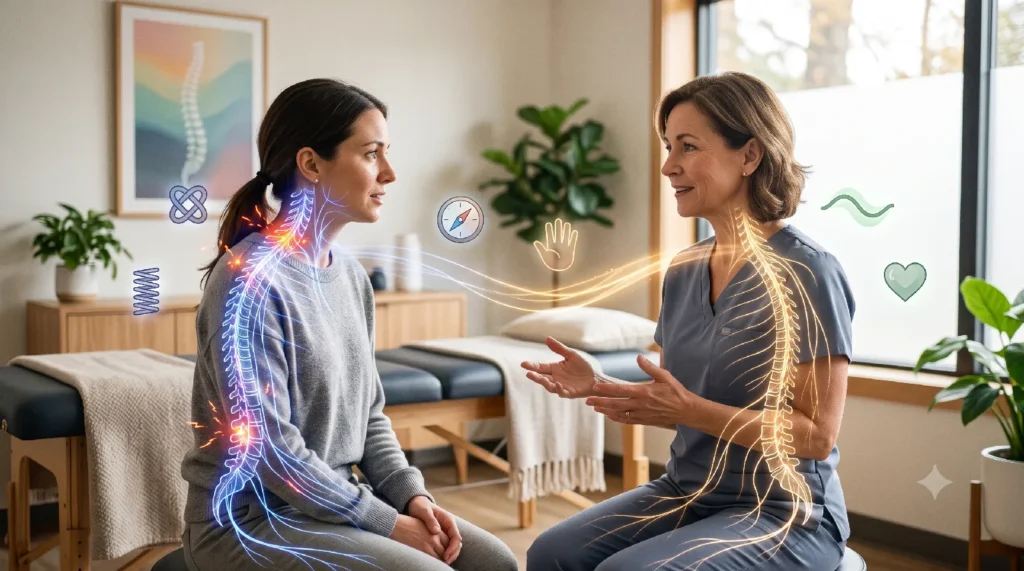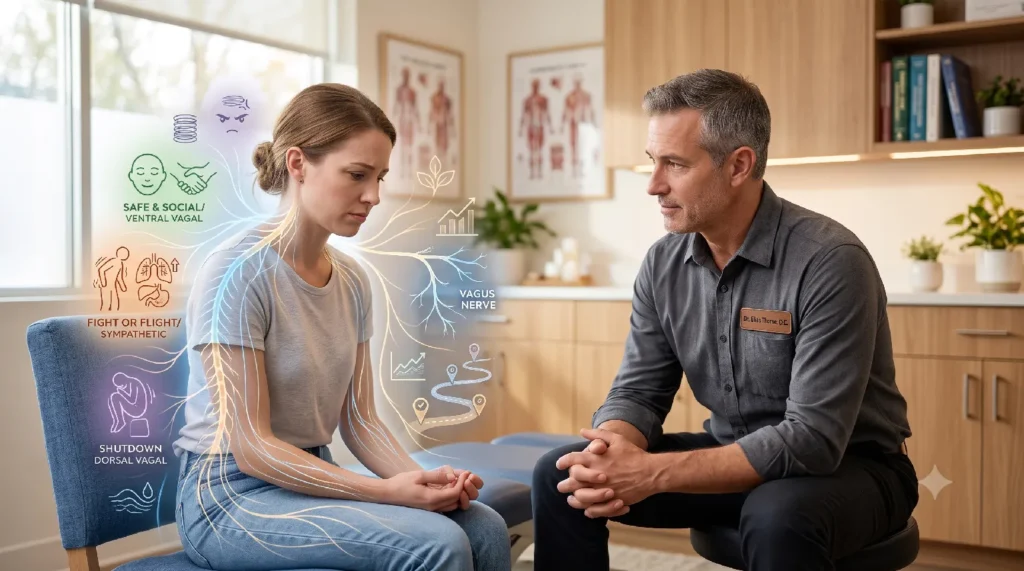

A patient walks into your office five minutes early, sits with her back to the wall, and keeps one eye on the front door.
She may tell you she is fine.
Her words may say one thing while her body is quietly preparing for something else.
Learning how to teach neuroception simply starts with helping people understand this gap without making them feel broken, analyzed, or blamed.
Over the years, I have found that patients rarely need a more complicated explanation of their nervous system.
What they need is language that helps them make sense of their experience.
When they can recognize why their body tightens, speeds up, shuts down, or settles, they often become less afraid of the reaction itself.
That is a meaningful beginning.
What Neuroception Means in Everyday Language
Neuroception is the nervous system’s automatic ability to scan for cues of safety, danger, or life threat.
The term comes from Polyvagal Theory, but the experience is familiar to everyone.
It is the reason you can feel relaxed around one person and guarded around another before either of you has said very much.
The key word is automatic.
Neuroception is not the same as perception.
Perception is what we consciously notice and think about.
Neuroception happens beneath conscious awareness.
I often explain it to patients like this:
Your nervous system is constantly asking one question: “Am I safe enough right now to connect, rest, digest, move, and heal?”
The body answers that question before the mind has a chance to.
Sometimes it gets the answer wrong.
A raised voice may be harmless yet trigger protection.
A busy waiting room may be completely safe yet still feel overwhelming.
That is not weakness.
It is adaptation.
How to Teach Neuroception Simply Without Overwhelming Patients
Start with the body, not the theory.
Most patients do not need a lecture on vagal pathways or autonomic physiology.
They need something practical.
You might say:
“Your body has a built-in safety scanner. It works before you have time to think. When it notices enough safety, your body can relax and connect. When it detects danger, it may tighten up, speed up, or pull away.”
Then pause.
Allow them to connect that idea to their own experience.
Patients often immediately recognize:
- Jaw tension before meetings
- Shallow breathing in crowded places
- Exhaustion after difficult conversations
- Tight shoulders during stress
Their examples are far more powerful than your explanation.
Use the Three-State Traffic Light Analogy
One of the simplest ways to explain neuroception is through a traffic light.
Green: Connection and Safety
In the green state, the nervous system feels safe enough to:
- Connect with others
- Learn
- Digest
- Recover
- Adapt
Life does not have to be perfect.
The system simply has enough flexibility to handle what is happening.
Yellow: Mobilization
Yellow represents activation.
People may feel:
- Anxious
- Restless
- Irritable
- Driven
- Tense
This state has a purpose.
It prepares us for action.
The problem occurs when the nervous system remains stuck there long after the challenge has passed.
Red: Shutdown and Disconnection
Red represents a deeper protective response.
People may experience:
- Fatigue
- Brain fog
- Numbness
- Withdrawal
- Low motivation
Again, this is not a character flaw.
It is often the body’s attempt to conserve energy when life feels overwhelming.
The goal is not to stay in green all day.
The goal is flexibility and a reliable path back toward connection.
Teach Through Observation, Not Correction
One of the most effective ways to teach neuroception is through gentle observation.
You may notice:
- Breath holding
- Raised shoulders
- A change in voice
- Restlessness
- Sudden silence
Rather than interpreting it for the patient, simply become curious.
Try saying:
“I noticed your breathing changed when you talked about that. Did you notice it too?”
That question creates awareness without judgment.
It helps patients become partners in understanding their own nervous system.
Co-Regulation Is Part of the Lesson
Human beings are social creatures.
We constantly read one another’s nervous systems.
That means your presence matters.
Patients notice:
- Your tone of voice
- Facial expressions
- Pace
- Energy
- Attention
Before an adjustment, even a simple statement can help:
“I’m going to explain what I’m checking first. If anything feels uncomfortable, let me know and we can slow down.”
This creates:
- Predictability
- Choice
- Trust
- Safety
Those are powerful nervous system signals.
Practical Ways to Help Patients Notice Safety
Once patients understand neuroception, encourage them to become investigators rather than judges.
Ask them:
- What helps you feel more settled?
- What helps you feel more like yourself?
- When do you notice your body softening?
Common answers include:
- Walking outside
- Sitting near a window
- Hearing a familiar voice
- Eating regularly
- Taking a break from screens
- Spending time with supportive people
Small inputs matter.
The nervous system is always gathering information.
Simple Practices Patients Can Try
You can also introduce small awareness exercises such as:
Notice Three Neutral Things
Ask patients to identify:
- Three things they can see
- Three sounds they can hear
- Three objects that feel neutral or pleasant
Feel the Support Beneath You
Invite them to notice:
- Their feet on the floor
- Their back against a chair
- The support of the adjusting table
Lengthen the Exhale
If comfortable, encourage a slightly longer exhale than inhale.
This is not about forcing relaxation.
It is simply offering the nervous system new information.
Let Neuroception Change the Way You Listen
Teaching neuroception is not about giving patients another diagnosis or label.
It is about helping them understand why their body reacts before their mind can explain it.
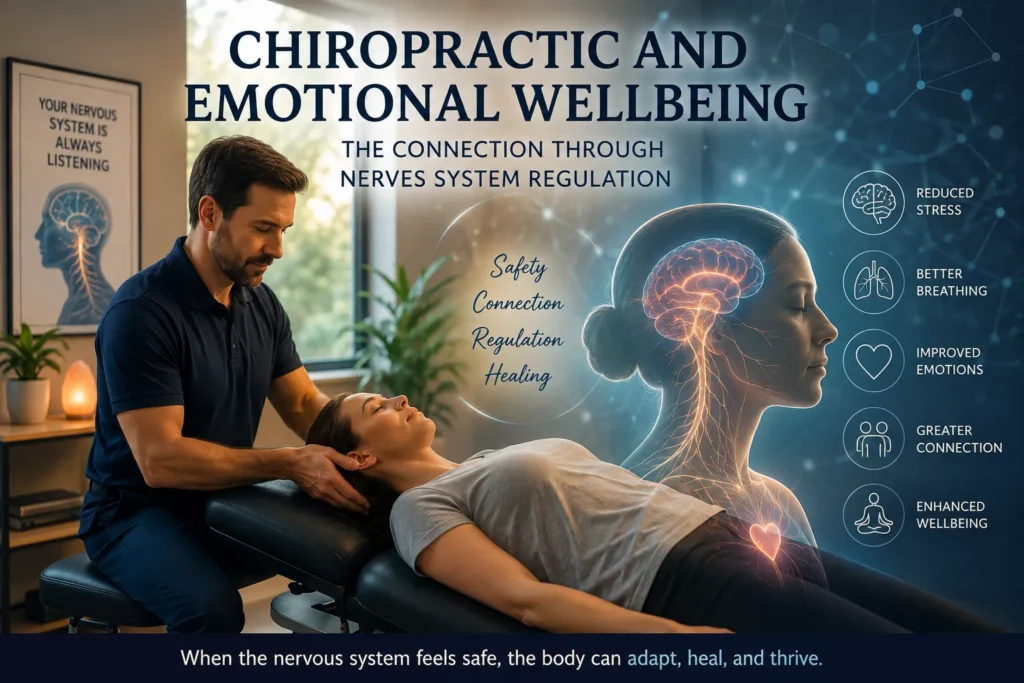
As chiropractors, we are uniquely positioned to help people reconnect with their bodies in a more hopeful way.
The next time a patient seems:
- Guarded
- Hurried
- Overwhelmed
- Numb
- Unable to settle
You may not need a better technique.
You may simply need to become curious alongside them.
A nervous system that has worked hard to protect someone often begins to change when it finally feels understood.
Frequently Asked Questions
What is neuroception?
Neuroception is the nervous system’s automatic process of detecting safety, danger, or life threat without conscious awareness.
Who developed the concept of neuroception?
Neuroception was introduced by Dr. Stephen Porges as part of Polyvagal Theory.
How is neuroception different from perception?
Perception is conscious awareness, while neuroception occurs automatically beneath conscious thought.
Why is neuroception important in chiropractic care?
Understanding neuroception helps chiropractors improve communication, build trust, and create conditions that support nervous system regulation.
Can neuroception affect healing?
Yes. When the nervous system continually detects danger, it may prioritize protection over recovery, repair, and connection.
What are signs of a protective nervous system response?
Common signs include muscle tension, shallow breathing, anxiety, irritability, fatigue, withdrawal, and difficulty relaxing.
How can chiropractors teach neuroception to patients?
Using simple analogies, observations, and everyday examples helps patients understand their nervous system without feeling overwhelmed.
Continue Learning
- The MacDonald Safety Corridor Protocol
- What Is Polyvagal Chiropractic?
- Polyvagal Theory for Chiropractors
- Nervous System Regulation
- Neuroception for Chiropractors
- Vagus Nerve and Chiropractic Care
- Chiropractic Communication
- Patient Retention and Trust

- Why Patients Leave Care and the Conversation That Keeps Them: Communication in Chiropractic with Dr. Don and Brandi MacDonald - October 26, 2026
- Why the Pelvic Floor May Be the Missing Link in Polyvagal Chiropractic - October 25, 2026
- Trend Lines: The Chiropractic Communication Skill That Keeps Practice Members in Care - October 12, 2026